- info@integrindt.com
- (+91) 96860 17690

Capillary-based detection of surface-breaking discontinuities in non-porous metallic and non-metallic components.
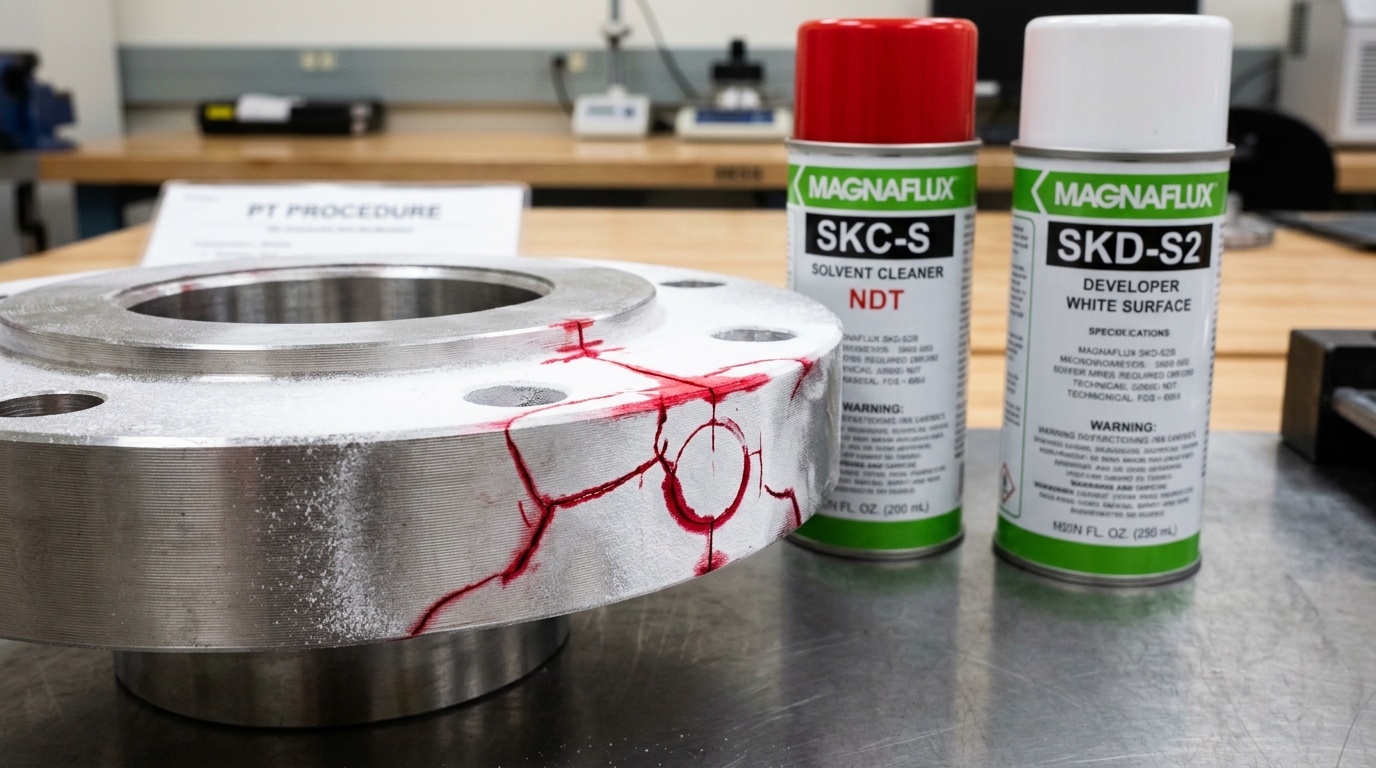
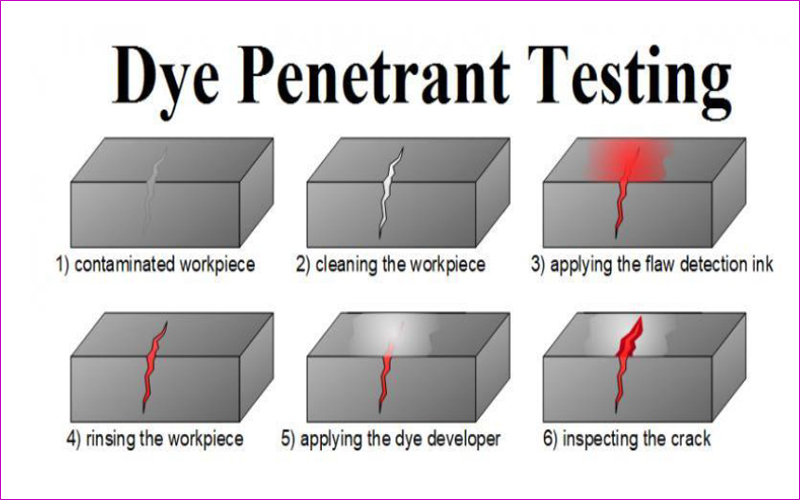
Liquid Penetrant Testing (LPT), commonly referred to as Dye Penetrant Inspection (PT), is one of the most widely applied NDT techniques for detecting open-to-surface flaws in non-porous materials. LPT relies on capillary action—the physical phenomenon where a low-viscosity liquid penetrant fluid is drawn into narrow surface openings regardless of gravitational orientation.
Because LPT does not rely on magnetic properties, it is the primary surface inspection method for non-ferromagnetic metals such as austenitic stainless steels, aluminum alloys, copper-nickel, titanium, and glazed ceramics.s.
| Method Code: | LPT / PT / DPI |
|---|---|
| Detection Type: | Surface-Breaking Discontinuities |
| Materials: | Non-Porous Metals & Non-Porous Synthetics |
| Primary Codes: | ASME V Article 6, ASTM E165/E165M |
Penetrant systems, developer types, temperature ranges, and code adherence for LPT examination.
| Specification Category | Technical Parameter & Scope |
|---|---|
| Discontinuity Types Detected | Surface cracks, porosity, pinholes, laps, cold shuts, lack of surface fusion, and stress-corrosion cracking that is open to the surface. |
| Material Compatibility | Austenitic stainless steels, aluminum alloys, brass, bronze, copper-nickel alloys, titanium, glazed ceramics, and suitable non-porous plastics and synthetic materials. |
| Applicable Codes & Standards | ASME Boiler & Pressure Vessel Code Section V, Article 6, ASTM E165/E165M, ASTM E1417/E1417M, AWS D1.2, ISO 3452-1, and ISO 23277. |
| Penetrant System Classification | Type I (Fluorescent Penetrant) and Type II (Visible Dye Penetrant); Method A (Water-Washable) and Method C (Solvent-Removable). |
| Developer Classification | Dry Powder Developer and Nonaqueous Wet Developer systems, selected according to the penetrant system and examination procedure. |
| Operating Temperature Limits | Standard examination temperature range: 40°F to 125°F (5°C to 52°C). Specialized high-temperature penetrant systems may be used at elevated temperatures when specifically qualified and approved for the application. |
Discuss your material types and surface testing requirements with our NDT technical team.
INTEGRI NDT provides Non-Destructive Testing (NDT) and dimensional inspection services for components, welds, fabricated structures, Machined components inspection, Forging inspection, Casting inspection and applicable industrial requirements.